FTSE Finish Line: August 12 — FTSE Chops Around Flat as Hormuz Uncertainty, GDP Wait and BoE Hike Risk Keep Bulls in Check
FTSE Finish Line: August 12 — FTSE Chops Around Flat as Hormuz Uncertainty, GDP Wait and BoE Hike Risk Keep Bulls in Check
London’s FTSE 100 spent Wednesday swinging between gains and losses, briefly dropping into negative territory. The session was defined by caution rather than conviction. Investors remained focused on the ongoing Middle East conflict and the unresolved question of whether the Strait of Hormuz will reopen. Hopes of a diplomatic breakthrough have repeatedly supported risk appetite in recent sessions, but fresh complications have also revived the oil and inflation risk premium. That has left UK equities moving sideways rather than extending July’s record-breaking advance.
The macro backdrop has become more difficult. Brent crude’s rebound above $90 earlier this week revived concerns that energy inflation could linger, while U.S.-Iran negotiations remain complicated by President Trump’s insistence that compensation demands from Iran be included in future talks. For UK markets, the Hormuz issue continues to cut both ways: de-escalation would help inflation and yields, but energy-price strength supports some index heavyweights while hurting consumers and rate-sensitive sentiment.
Mining stocks provided Wednesday’s clearest support. Endeavour Mining rose 3.3%, Fresnillo gained 3%, and Anglo American added 1.6%. The strength in Endeavour and Fresnillo suggested continued demand for precious-metals exposure as investors retained hedges against geopolitical uncertainty. Anglo American’s gain pointed to more selective interest in diversified miners despite the broader lack of direction.
Housebuilders also performed well. Barratt Redrow and Persimmon gained between 1.5% and 3%, continuing their sensitivity to the interest-rate outlook and domestic policy expectations. The sector has been volatile in recent weeks, rallying when oil-price falls lowered yields and inflation fears, then giving some ground back when crude rebounded. Wednesday’s gains suggested investors were still prepared to buy housing names on hopes that domestic growth softness will limit how far the Bank of England can tighten.
That optimism is being tested. Traders are now pricing in a 46% chance of a 25-basis-point Bank of England rate hike by December. That is a meaningful shift from the earlier post-meeting interpretation that the BoE was not edging toward a hike, even after the 6-3 vote split at the last policy meeting. Governor Bailey’s guidance remains important, but markets are increasingly sensitive to any evidence that energy and wage pressures are becoming persistent.
The latest labour-market survey added to that sensitivity. Permanent hiring stabilised in July after a 45-month downturn, and temporary billings grew at the fastest pace in three years. That was encouraging for activity, but pay growth also picked up, with starting salary inflation at a six-month high and temp wage growth at a 26-month high. Combined with renewed oil strength, that has made investors more willing to price a December hike risk.
Thursday’s UK GDP data are therefore an important next test. Economists expect growth to have stalled on a month-on-month basis in June after 0.1% growth in May. A flat reading would reinforce the view that the economy is losing momentum and could argue against further tightening. But if inflation and wage signals remain firm, the Bank of England may still be forced to keep policy restrictive even in a softer growth environment.
That is the uncomfortable macro mix facing UK equities: weak growth risk, higher energy risk and uncertain rates. It does not necessarily imply a sharp market fall, because the FTSE has strong international earnings exposure and support from miners, energy and defensives. But it does make broad-based upside harder to sustain, especially after July’s repeated record highs.
Among other gainers, Admiral, 3i Group, Melrose, Halma, Rolls-Royce, Polar Capital Technology Trust and Land Securities advanced between 1.5% and 3%. Babcock, BAE Systems, St. James’s Place, Aberdeen Group, Lion Finance, ICG and Smiths Group also posted solid gains. The strength in defence names showed that geopolitical uncertainty still supports security-linked stocks, even when the broader market is cautious.
Rolls-Royce continued to attract interest after its earlier guidance upgrade, and Melrose’s gain showed support for industrials with self-help or recovery stories. Land Securities’ move suggested some selective buying in real estate, possibly linked to expectations that weak GDP could cap rate expectations despite the market’s growing December hike probability.
On the downside, consumer and healthcare names weighed on the index. Marks & Spencer shed more than 3%, while Burberry dropped 2.9% and Tesco fell 2.7%. Sainsbury also declined. The weakness reflected ongoing concerns about consumer spending after British Retail Consortium data showed like-for-like retail sales rose just 1% year-on-year in July, below expectations and the softest growth since February.
Retailers are especially exposed to the renewed oil-price squeeze. Higher fuel and energy costs threaten discretionary spending and can erode the benefit of any wage growth. The market is now questioning whether the consumer recovery is strong enough to withstand both higher prices and still-restrictive interest rates.
Luxury and discretionary names face additional pressure. Burberry’s decline pointed to persistent concerns about global luxury demand, while Marks & Spencer and Next’s weakness suggested investors were cautious on UK household spending into the second half. Tesco and Sainsbury’s falls showed that even food retailers were not immune, despite their defensive characteristics.
Healthcare also dragged. AstraZeneca, GSK and Haleon fell between 1% and 1.6%, while Reckitt Benckiser also declined. AstraZeneca remains under scrutiny after earlier reports of discussions with Bristol Myers Squibb about a possible merger, and Smith & Nephew’s recent guidance downgrade has added caution toward medical names. In a flat market, heavyweight healthcare weakness matters.
BP slipped despite the broader energy-risk backdrop, suggesting some profit-taking after recent gains tied to Brent’s rebound. IG Group also declined after its recent partial recovery, while RELX and Bunzl weakened. Investors continue to be selective, rewarding clear earnings beats or capital-return stories but punishing uncertainty, stretched valuations or lack of fresh catalysts.
Prime Minister Andy Burnham’s comments added a domestic policy layer. In a BBC interview, he said his government would do what it can to help lower costs for business, while acknowledging a “difficult financial outlook.” Markets are likely to welcome the intent to ease business pressure, particularly after weak construction and retail signals, but the phrase also underlines the fiscal constraints facing the government.
The challenge for Burnham’s government is to provide targeted relief without unsettling gilt markets or complicating the inflation outlook. Measures to reduce business costs could support margins and hiring, but if they are perceived as fiscally loose or inflationary, they could work against the BoE’s efforts to keep expectations anchored. Investors will therefore watch both the scale and funding of any policy package.
Finish Line: The FTSE 100 chopped around flat, as investors weighed Middle East risks, Hormuz uncertainty and the upcoming UK GDP release. Miners led gains, with Endeavour and Fresnillo up more than 3%, while housebuilders, defence names and selected industrials also rose. Consumer and healthcare stocks dragged, with Marks & Spencer, Burberry, Tesco, AstraZeneca, GSK and Haleon weaker. Markets are now pricing a 46% chance of a 25bp BoE hike by December, showing that oil strength and firmer wage signals have revived inflation concerns. Thursday’s GDP data will be crucial: weak growth could restrain hike expectations, but persistent energy and pay pressures mean the BoE’s hold narrative is no longer risk-free.
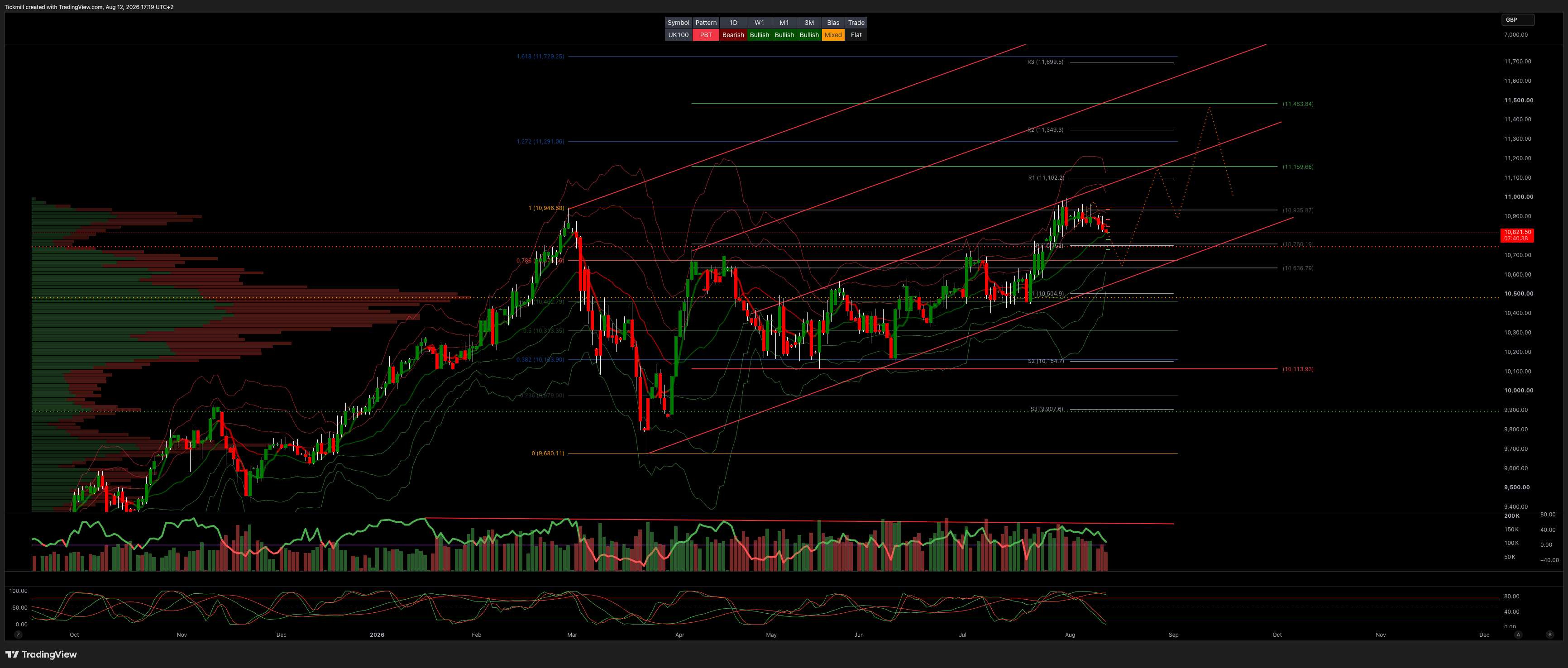
TECHNICAL & TRADE VIEW – FTSE100
Daily VWAP Bearish
Weekly VWAP Bullish
Above 10700 Target 11150
Below 10400 Target 9500
Disclaimer: The material provided is for information purposes only and should not be considered as investment advice. The views, information, or opinions expressed in the text belong solely to the author, and not to the author’s employer, organization, committee or other group or individual or company.
Past performance is not indicative of future results.
High Risk Warning: CFDs are complex instruments and come with a high risk of losing money rapidly due to leverage. 69% and 73% of retail investor accounts lose money when trading CFDs with Tickmill UK Ltd and Tickmill Europe Ltd respectively. You should consider whether you understand how CFDs work and whether you can afford to take the high risk of losing your money.
Futures and Options: Trading futures and options on margin carries a high degree of risk and may result in losses exceeding your initial investment. These products are not suitable for all investors. Ensure you fully understand the risks and take appropriate care to manage your risk.
Patrick has been involved in the financial markets for well over a decade as a self-educated professional trader and money manager. Flitting between the roles of market commentator, analyst and mentor, Patrick has improved the technical skills and psychological stance of literally hundreds of traders – coaching them to become savvy market operators!